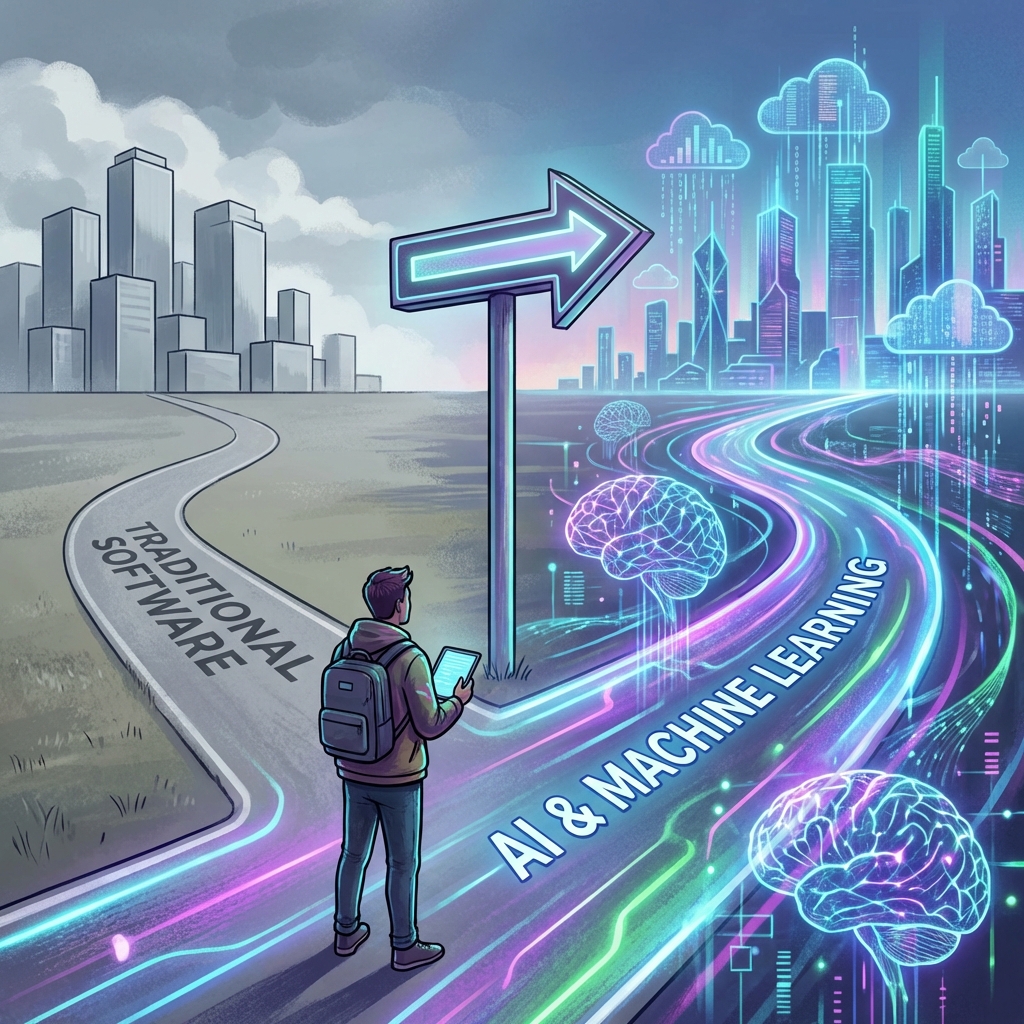
Let me be blunt: If you're a developer in 2026 and you're not learning ML engineering or integrating AI agents into your products, you're leaving money on the table.
Not just a little money. A LOT of money.
And more importantly, you're watching the biggest technological shift of your career pass you by.
The Wake-Up Call
Here's a reality check:
- OpenAI is valued at $150+ billion
- Every major tech company is restructuring around AI
- Startups with AI-first products are raising billions
- Job postings for ML engineers have 3x'd in 2 years
- Products without AI are starting to feel... outdated
This isn't hype. This is a fundamental shift in how software works.
The question isn't "should I learn AI?"
The question is: "How fast can I learn it before my competition does?"
What "ML Engineer" Actually Means in 2026
Forget the old definition. ML Engineering isn't just about training models from scratch (though that's still valuable). Today's ML Engineer:
- Integrates AI into existing products
- Fine-tunes pre-trained models for specific use cases
- Builds agents that can take autonomous actions
- Designs AI-native user experiences
- Optimizes AI pipelines for production
You don't need a PhD. You don't need to understand every math equation. You need to know how to build things that work.
The AI-Enabled Product Advantage
Let me show you the difference AI makes:
Traditional SaaS Product:
User: *uploads spreadsheet*
Product: *shows spreadsheet*
User: *manually creates formulas*
User: *manually generates reports*
User: *manually extracts insights*
Result: Hours of work
AI-Enabled Product:
User: *uploads spreadsheet*
Product: "Here are 5 insights I found. Want me to generate a report?"
User: "Yes, and email it to my team"
Product: *Done*
Result: 2 minutes
Same problem. 100x better experience.
Which product wins customers?
Why Products Without AI Are Dying
Here's what's happening in every market:
- New AI-native startup enters the space
- Traditional product says "AI is just hype"
- Users try both, see 10x productivity gain with AI
- Traditional product starts losing customers
- Traditional product rushes to add AI (too late, playing catch-up)
- AI-native startup becomes the new leader
I've seen this play out in:
- Design tools (Figma vs AI alternatives)
- Writing software (Google Docs vs AI writing tools)
- Customer support (Traditional helpdesks vs AI agents)
- Development (Manual coding vs AI-assisted development)
- Analytics (Dashboard tools vs conversational analytics)
The pattern is the same everywhere.
The Agent Revolution
Here's where it gets really exciting: AI Agents.
Regular AI: "Here's some information" AI Agents: "I'll handle this task for you from start to finish"
Agents can:
- Book meetings
- Write and send emails
- Research topics
- Generate reports
- Update databases
- Monitor systems
- Handle customer inquiries
- And so much more...
If your product has repetitive workflows, agents can automate them.
This is a MASSIVE differentiation opportunity.
What You're Missing Out On
If you're not integrating AI agents into your products, here's what you're leaving behind:
1. Revenue
AI features command premium pricing. Users will pay 2-3x for AI-powered versions.
2. Retention
"Magical" AI experiences create sticky products. Users don't want to go back.
3. Efficiency
AI reduces support tickets, automates onboarding, and scales without headcount.
4. Market Position
First-movers in AI dominate mindshare. "The AI-powered [X]" is a powerful position.
5. Career Growth
ML engineers are among the highest-paid roles in tech. Period.
How to Get Started (The Practical Path)
You don't need to quit your job and do a 2-year masters. Here's the pragmatic path:
Phase 1: Integrate (Week 1-4)
Start using AI APIs in your existing products:
- Add OpenAI/Anthropic API calls
- Implement a simple chat feature
- Use embeddings for search/recommendations
- Build a basic RAG (Retrieval Augmented Generation) system
# It's literally this simple to start
from openai import OpenAI

client = OpenAI()

response = client.chat.completions.create(
    model="gpt-4",
    messages=[
        {"role": "system", "content": "You are a helpful assistant for our product."},
        {"role": "user", "content": user_query}
    ]
)
Phase 2: Enhance (Month 2-3)
Level up your integration:
- Fine-tune models on your domain data
- Build multi-step workflows
- Add memory/context management
- Implement function calling for actions
Phase 3: Build Agents (Month 3-6)
Create autonomous agents:
- Define tool sets for your agents
- Implement agent loops with planning
- Add guardrails and safety measures
- Create multi-agent systems
Phase 4: Productize (Ongoing)
Turn AI into competitive advantage:
- Build AI-native features users love
- Create unique AI experiences competitors can't copy
- Develop proprietary datasets and fine-tuned models
The Skill Stack That Pays
Focus on these skills (in order):
- API Integration - Using OpenAI, Anthropic, etc.
- Prompt Engineering - Getting reliable outputs from LLMs
- Vector Databases - Pinecone, Weaviate, ChromaDB
- RAG Systems - Retrieval + Generation pipelines
- Agent Frameworks - LangChain, CrewAI, AutoGPT
- Fine-tuning - Customizing models for your use case
- MLOps - Deploying and monitoring ML in production
You don't need all of these to start. Start with #1 and #2.
The Cost of Waiting
Every month you wait:
- Competitors integrate AI into their products
- The talent market gets more competitive
- Users' expectations of "intelligent" products rise
- The knowledge gap between you and ML engineers grows
There is no better time to start than right now.
Real Talk: Objections Addressed
"I don't have ML background"
Neither did I when I started. The tools have gotten SO accessible. If you can code, you can integrate AI.
"My product doesn't need AI"
Your product might not need AI. But your COMPETITORS are adding it. How will you differentiate?
"It's too expensive"
API costs have dropped 90%+ in 2 years. Fine-tuning is cheap. Small models run locally. This objection is outdated.
"AI is just hype"
The iPhone was also "just hype" in 2007. Ask Nokia how ignoring it worked out.
"I'll learn it later"
Later = playing catch-up instead of leading. The best time to start was yesterday. The second best is today.
My Challenge to You
Here's what I want you to do this week:
- Pick ONE feature in your product that could benefit from AI
- Build a prototype using OpenAI or Claude API
- Test it with real users
- Measure the improvement in user experience
I guarantee you'll be hooked.
The future of software is intelligent, autonomous, and personalized. Every product will have AI woven into its core.
The only question is: Will you be building that future, or watching others build it?
The Bottom Line
- ML Engineering is the most valuable skill you can learn in 2026
- AI Agents are transforming how products work
- Products without AI are being disrupted across every industry
- The barrier to entry has never been lower
- The cost of waiting is higher than the cost of learning
Stop watching from the sidelines. Start building.
Your future self will thank you.
Are you integrating AI into your products? Hit me up—I'd love to see what you're building! And if you're just getting started, drop a comment with your questions. We're all learning together. 🚀