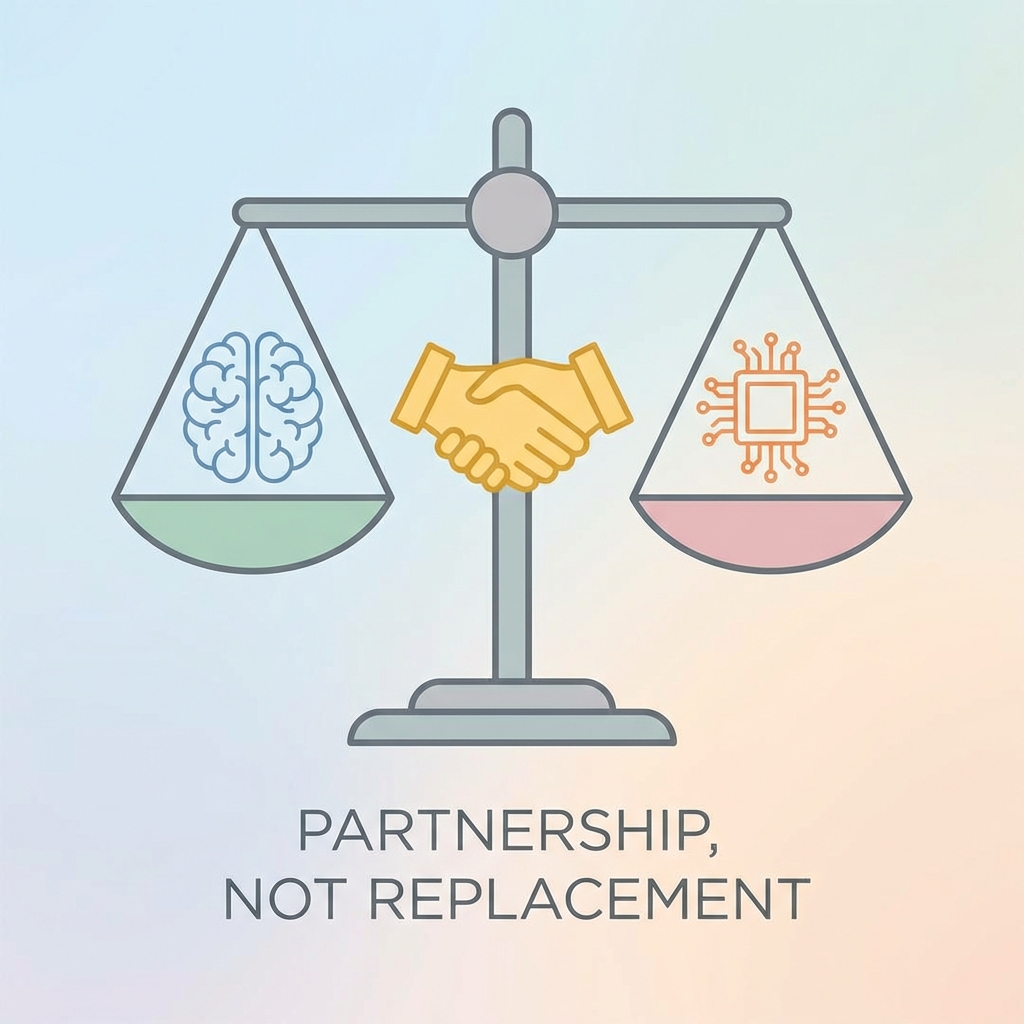
Every few months, a new headline screams: "AI Will Replace 80% of Jobs!" or "Developers Are Doomed!"
And every time, I roll my eyes.
Not because AI isn't powerful—it absolutely is. But because this narrative completely misses the point. Let me explain why AI isn't here to replace you. It's here to make you ridiculously more effective.
The Fear Factory
Let's address the elephant in the room. Why is everyone so scared?
- Media sensationalism - Fear sells clicks
- Impressive demos - AI can write code! Generate art! Pass exams!
- Historical precedent - Automation HAS replaced jobs before
- Uncertainty - Nobody knows exactly how this plays out
All valid concerns. But here's what the doom-and-gloom crowd gets wrong:
Technology has ALWAYS changed jobs. It rarely eliminates them entirely.
A Brief History of "We're All Doomed"
Let's take a trip down panic lane:
The Printing Press (1440)
- Fear: Scribes will lose their jobs!
- Reality: Books became accessible. Literacy exploded. New industries emerged.
The Automobile (1900s)
- Fear: Horse-related jobs will vanish!
- Reality: Millions of new jobs in manufacturing, repair, gas stations, roads, tourism...
Computers (1980s-90s)
- Fear: Offices will be empty! Secretaries are obsolete!
- Reality: More office jobs than ever. New industries. New roles.
The Internet (2000s)
- Fear: Retail is dead! Newspapers are finished!
- Reality: E-commerce created millions of jobs. Digital media exploded.
Notice a pattern?
Disruption ≠ Destruction
What AI Actually Does For Developers
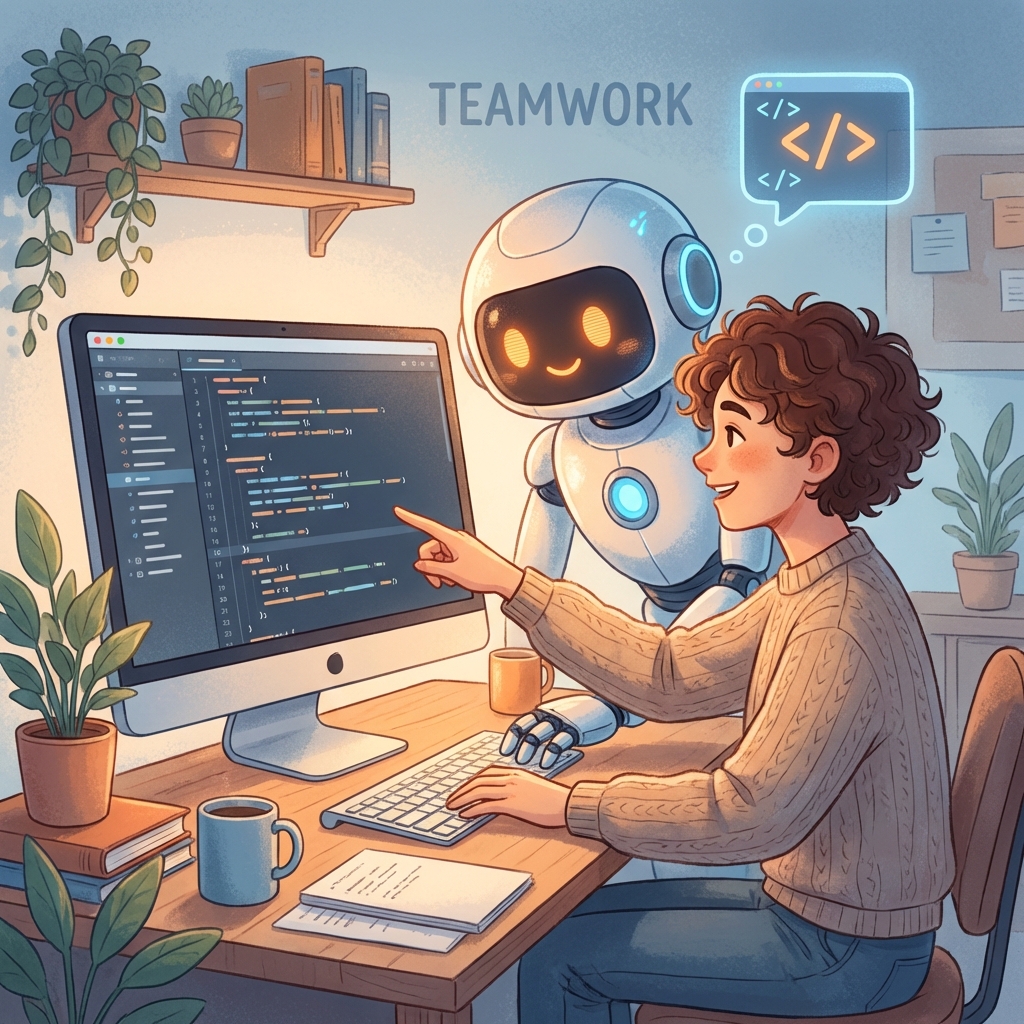
I've been using AI tools daily for over a year. Here's my honest experience:
What AI Handles Well:
- ✅ Boilerplate code
- ✅ Documentation lookup
- ✅ Debugging common errors
- ✅ Code explanations
- ✅ Repetitive refactoring
- ✅ Test generation
- ✅ Quick prototyping
What AI Struggles With:
- ❌ Understanding business context
- ❌ Making architectural decisions
- ❌ Knowing what to build
- ❌ User empathy
- ❌ Creative problem-solving
- ❌ Edge cases in complex systems
- ❌ Debugging production issues with incomplete information
AI is like having a super-fast junior developer who:
- Types at the speed of light
- Has read every Stack Overflow post
- Never gets tired
- But also never asks "should we even build this?"
The New Developer Superpower
Here's the thing: AI makes good developers GREAT, and great developers EXCEPTIONAL.
Before AI:
Task: Build user authentication
Time: 2-3 days
Manual work: Lots of boilerplate, security research, testing setup
With AI:
Task: Build user authentication
Time: 2-3 hours
You focus on: Security decisions, edge cases, user experience
AI handles: Boilerplate, docs lookup, test scaffolding
Same output. Fraction of the monotonous work.
The ceiling for what a single developer can accomplish has never been higher.
Skills That AI Can't Replace
Want to be "AI-proof"? Focus on these:
1. Problem Identification
AI can solve problems. But knowing WHAT to solve? That requires human insight, customer empathy, and business understanding.
2. System Thinking
How do all the pieces fit together? What are the tradeoffs? AI gives options. You make the calls.
3. Communication
Explaining technical decisions to stakeholders. Mentoring juniors. Building consensus. Still very human.
4. Creativity
The truly novel ideas. The "what if we tried..." moments. AI remixes what exists. Humans create what doesn't.
5. Judgment
When to ship. When to refactor. When to say "no." AI doesn't understand deadlines, politics, or technical debt payoff.
The Real Risk: Developers Who DON'T Use AI
Here's the uncomfortable truth:
The threat isn't AI taking your job. It's AI-enabled developers outperforming you.
If you're writing every line of code manually while your competition uses AI to ship 3x faster... who gets the job?
It's like refusing to use Google in 2005 because "real developers memorize everything."
How to Work WITH AI
Here's my playbook:
1. Use AI as a Starting Point, Not the Finish Line
Generate code, then review critically. AI writes the first draft. You edit for quality.
2. Stay in the Driver's Seat
You decide architecture. You set standards. AI executes.
3. Learn Prompting as a Skill
The better you can communicate with AI, the better results you get. It's a new form of "programming."
4. Don't Outsource Understanding
If AI writes code you don't understand, you have a problem. Always know what your code does.
5. Focus on the "Why"
AI handles "how to implement X." You handle "why we need X" and "what X should actually be."
The Future: Collaborative Intelligence
Here's my prediction:
The best teams of the future will be humans + AI, not one or the other.
Think about it:
- Designers + AI = More creative exploration, faster iteration
- Developers + AI = More features shipped, less grunt work
- Product managers + AI = Better research, faster validation
The winners won't be the ones who resist AI. They'll be the ones who master the human-AI collaboration dance.
A Personal Note
I'll be honest: When AI coding tools first emerged, I felt the fear too. Was everything I'd learned becoming worthless?
After months of using AI daily, here's what I've found:
My job hasn't disappeared. It's transformed.
I spend less time on boring stuff. More time on interesting problems. I ship faster. I learn faster. I enjoy my work more.
AI hasn't made me obsolete. It's made me amplified.
TL;DR
- AI isn't coming for your job—stagnation is
- Technology transforms jobs; it rarely eliminates them
- AI makes good developers more productive
- Focus on skills AI can't replace: judgment, creativity, communication
- The real risk is NOT using AI while competitors do
- Human + AI > Human alone OR AI alone
Final Thought
Stop worrying about being replaced by AI.
Start wondering what you could build if you had an AI as your teammate.
The future belongs to the augmented developer—humans who leverage AI to do things that would be impossible alone.
That's not a threat. That's an opportunity.
What's your experience with AI tools? Has it changed how you work? Drop a comment—I'd love to hear your story! 💙